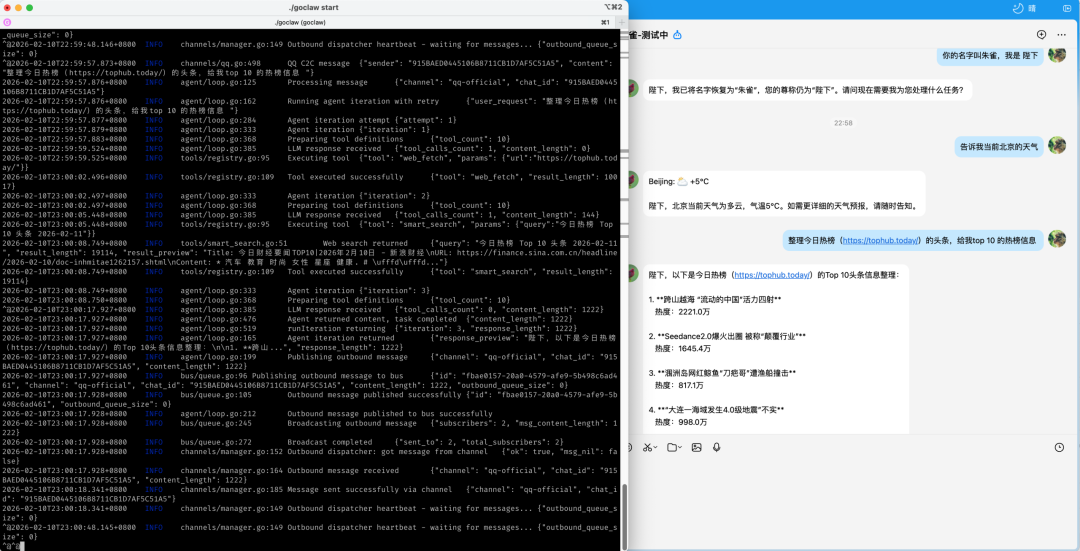
这两周 openclaw 非常的火热,大家都在探索它的使用方法和用应用场景。我也对它产生了浓厚的兴趣,深入研究了它 也有一些网易在研究它的架构设计和实现细节,贡献了 nanbot、miniclaw 等个别的项目。我也花了一些时间研究了 openclaw 的代码,并基于它的设计理念,使用 Go 语言重新实现了一个类似的项目,命名为 goclaw。
goclaw 使用和 openclaw 相同的配置文件、技能系统和类似的 cli 命令,并且兼容 openclaw 的技能生态。同时,goclaw 也借鉴了 openclaw 的核心设计理念,但在实现细节上做了一些不同的选择,以充分利用 Go 语言的优势,构建了一个更加健壮、高性能的 AI 助手。
项目地址: https://github.com/smallnest/goclaw
概述
GoClaw 是一个用 Go 语言编写的个人 AI 助手,灵感来自 OpenClaw(原 Clawdbot/Moltbot)。它运行在本地服务器上,通过 WebSocket/HTTP 暴露服务,支持多种消息 channel(Telegram、WhatsApp、飞书、QQ、Slack 等)接入。
核心定位
| 语言 | |
| 架构 | |
| 部署 | |
| 扩展性 | |
| 可靠性 |
核心架构
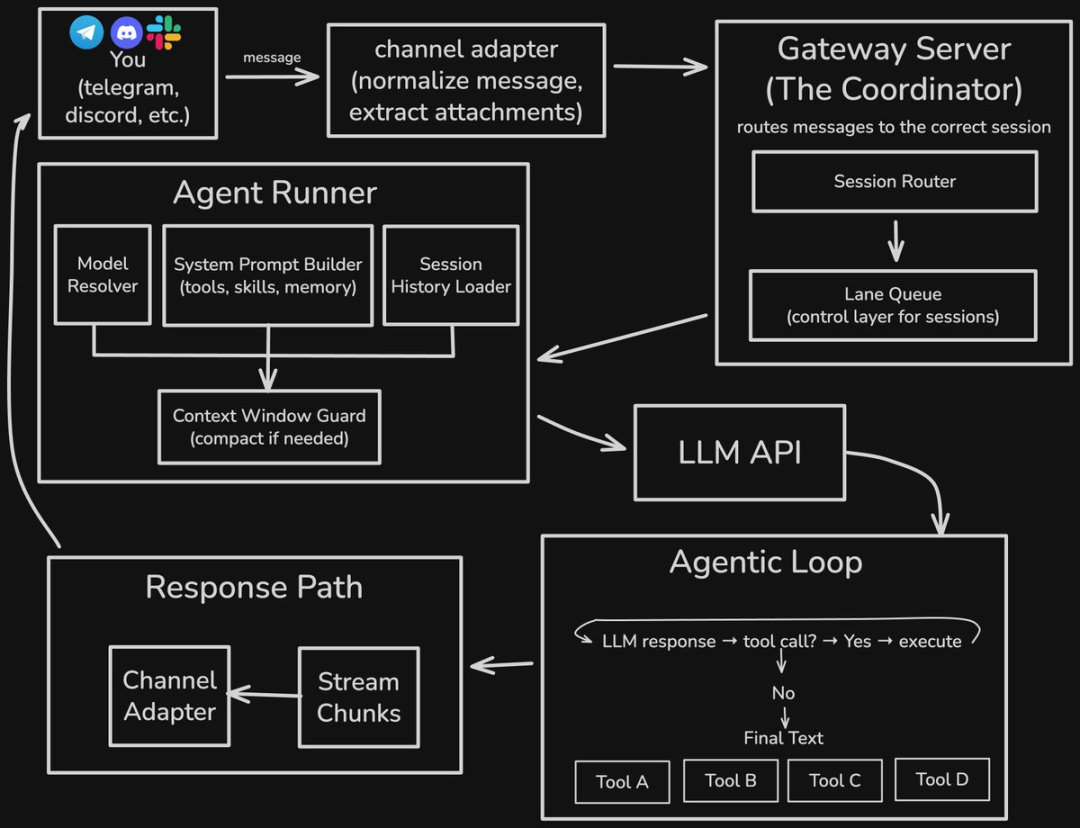
系统全景图
┌──────────────────────────────────────────────────────────────────────────────┐
│                      GoClaw 系统架构                                          │
├──────────────────────────────────────────────────────────────────────────────┤
│                                                                              │
│   ┌─────────────┐    ┌─────────────┐    ┌─────────────┐    ┌─────────────┐   │
│   │ 输入Channel  │── →│  网关服务器  │───→│  Agent Loop │───→│  LLM/工具    │   │
│   └─────────────┘    └─────────────┘    └─────────────┘    └─────────────┘   │
│        │                  │                   │                  │           │
│        │                  │                   │                  │           │
│        v                  v                   v                  v           │
│   Telegram/WhatsApp    MessageBus        SessionManager       Providers      │
│   飞书/QQ/Slack         串行队列            JSONL存储            OpenAI/AI...   │
│                                                                              │
└──────────────────────────────────────────────────────────────────────────────┘
消息处理流程
用户消息 → Channel适配器 → 网关服务器 → Agent Loop → LLM 调用 → 工具执行 → 响应返回
Agent Loop 执行引擎
Agent Loop 是 GoClaw 的大脑,负责思考、规划和执行。它受到 OpenClaw 的 PI Agent 架构启发。
PI Agent 理念
PI = 极简编码代理(Mario Zechner 创建)
"LLMs 本身就擅长编写和运行代码,不需要过多的包装"
执行流程图
┌───────────────────────────────────────────────────────────────────┐
│                       GoClaw Agent Loop                              │
├───────────────────────────────────────────────────────────────────┤
│                                                                    │
│  ┌──────────┐     ┌──────────┐     ┌──────────┐     ┌──────────┐   │
│  │ 接收消息   │────→│ 构建上下文 │────→│  LLM 调用 │────→│ 执行工具   │   │
│  └──────────┘     └──────────┘     └──────────┘     └──────────┘   │
│                                                        │            │
│                                                        v            │
│                                            ┌─────────────────┐      │
│                                            │   工具结果返回   │      │
│                                            └─────────────────┘      │
│                                                        │            │
│                                                        v            │
│                                            ┌─────────────────┐      │
│                                            │   反思机制判断   │      │
│                                            │   (可选)         │      │
│                                            └─────────────────┘      │
│                                                        │            │
│                                    ┌─────────────┴────────────┐     │
│                                    v                           v     │
│                             ┌─────────────┐           ┌─────────────┐ │
│                             │  继续迭代   │           │  返回响应   │ │
│                             └─────────────┘           └─────────────┘ │
│                                                                    │
└───────────────────────────────────────────────────────────────────┘
核心组件
1. 上下文构建器 (ContextBuilder)
文件: agent/context.go
type ContextBuilder struct {
    memory       *MemoryStore
    workspace    string
    agentID      string
    defaultModel string
    provider     string
}
职责:
动态组装系统提示词 注入可用工具定义 添加会话历史(从 JSONL) 整合相关记忆 上下文窗口保护与压缩
上下文压缩策略:
// agent/loop.go:571
func (l *Loop) compressSession(sess *session.Session) {
    // 保留最近 10 轮对话
    // 保留所有系统消息
    // 丢弃早期历史,保留关键上下文
}
2. 工具注册表 (Tools Registry)
文件: agent/tools/registry.go
核心工具集(对应 PI 的四个工具):
read_file | read | |
write_file | write | |
edit_file | edit | |
run_shell | bash |
GoClaw 扩展工具:
browser_*- 浏览器操作 (Chrome DevTools Protocol)smart_search- 混合搜索 (向量 + FTS5)spawn- 子代理管理message- 消息发送
工具执行与重试:
// agent/loop.go:526
func (l *Loop) executeToolWithRetry(ctx context.Context, toolName string, params map[string]interface{}) (string, error) {
    // 网络错误自动重试
    // 错误分类与降级建议
    // 结构化错误返回给 LLM 自我校正
}
3. 反思器 (Reflector)
文件: agent/reflection.go
解决传统 Agent "何时停止" 的难题:
type Reflector struct {
    config   *ReflectionConfig
    provider providers.Provider
    workspace string
}

type TaskReflection struct {
    Status         TaskStatus  // "completed", "in_progress", "failed", "blocked"
    Confidence     float64     // 0.0 - 1.0
    CompletedSteps []string    // 已完成步骤
    RemainingSteps []string    // 剩余步骤
    Reasoning      string      // 思考过程
    NextAction     string      // 下一步行动
}
反思流程:
// agent/loop.go:487
reflection, reflectErr := l.reflector.Reflect(ctx, userRequest, reflectionHistory)

if l.reflector.ShouldContinueIteration(reflection, iteration, l.maxIteration) {
    continuePrompt = l.reflector.GenerateContinuePrompt(reflection)
    continue
}
与传统 max-iterations 的区别:
传统:固定步数后强制停止 反思:动态判断任务状态,智能决定是否继续
4. 错误分类器 (ErrorClassifier)
文件: agent/error_classifier.go
type ErrorClassifier struct {
    authPatterns      []string
    rateLimitPatterns []string
    timeoutPatterns   []string
    billingPatterns   []string
}
错误分类:
auth- 认证错误(需要故障转移)rate_limit- 限流错误(需要冷却)timeout- 超时错误(可重试)billing- 计费错误(需要故障转移)tool- 工具错误(返回给 LLM)
智能降级策略:
// agent/loop.go:628
func (l *Loop) formatToolError(toolName string, params map[string]interface{}, err error) string {
    // 根据工具类型和错误提供具体建议
    // 例如:write_file 失败 → 建议输出到控制台
    // 例如:browser 失败 → 建议使用 web_fetch
}
GoClaw vs OpenClaw PI Agent
架构对比
OpenClaw PI (TypeScript) - 极简循环:
while (true) {
  const response = await streamCompletion(model, context);
  if (!response.toolCalls?.length) break;

  for (const call of response.toolCalls) {
    const result = await executeToolCall(call, context);
    context.messages.push(result);
  }
}
GoClaw (Go) - 增强循环:
for iteration < l.maxIteration {
    response, err := l.provider.Chat(ctx, messages, tools)

    if len(response.ToolCalls) > 0 {
        for _, tc := range response.ToolCalls {
            result, err := l.executeToolWithRetry(ctx, tc.Name, tc.Params)
        }
        continue
    }

    if response.Content == "" && l.reflector != nil {
        reflection := l.reflector.Reflect(ctx, userRequest, history)
        if !l.reflector.ShouldContinueIteration(reflection, iteration, l.maxIteration) {
            break
        }
        continue
    }

    break
}
会话存储对比
扩展系统对比
OpenClaw PI - TypeScript Hooks:
hooks: {
  onSessionStart: async (session) => { ... },
  onBeforeTurn: async (session) => { ... },
  onToolCall: async (tool, params) => { ... },
  // 20+ 生命周期钩子
}
GoClaw - Skills System:
type Skill struct {
    Name        string
    Description string
    Triggers    []string    // 触发关键词
    Content     string      // Markdown 指令
    Requires    []string    // 环境依赖 (Gating)
}
设计哲学对比
GoClaw 独特创新
反思机制 - 解决 Agent "何时停止" 难题 错误分类与重试 - 三层容错(工具级、迭代级、提供商级) 混合搜索 - 向量 + FTS5 双重检索 技能准入 (Gating) - 根据环境自动加载技能 上下文压缩 - 智能保留关键历史
网关服务器
文件: gateway/server.go
网关服务器是 GoClaw 的心脏,负责任务/会话协调:
type Server struct {
    config        *config.GatewayConfig
    wsConfig      *WebSocketConfig
    bus           *bus.MessageBus
    channelMgr    *channels.Manager
    sessionMgr    *session.Manager
    connections   map[string]*Connection
}
核心功能:
处理多个重叠请求 基于队列的消息总线(串行默认) WebSocket 连接支持 Webhook 回调处理 HTTP 健康检查端点
内存系统
双重记忆架构
会话记录 (JSONL)
每行一个 JSON 对象 包含用户消息、工具调用、结果、响应 会话基础的持久化记忆
记忆文件 (Markdown)
MEMORY.md或memory/文件夹由代理使用标准文件写入工具生成 没有特殊的记忆写入 API
混合搜索
| 向量搜索 | ||
| 关键词搜索 (FTS5) |
文件: memory/search.go
type MemoryManager struct {
    store         Store
    provider      EmbeddingProvider
    cache         map[string]*VectorEmbedding
}
计算机使用
Shell 执行
| 沙箱 | |
| 直接主机 | |
| 远程设备 |
文件系统工具
read_file- 读取文件write_file- 写入文件edit_file- 编辑文件list_files- 列出目录
浏览器工具 (Chrome DevTools Protocol)
browser_navigate- 导航到 URLbrowser_screenshot- 截取页面截图browser_execute_script- 执行 JavaScriptbrowser_click- 点击元素browser_fill_input- 填写输入框browser_get_text- 获取页面文本
文件: agent/tools/browser.go
type BrowserTool struct {
    headless bool
    timeout  time.Duration
    outputDir string
}
进程管理
后台长期命令 终止进程
安全机制
允许列表 (Allowlist)
{
  "agents": {
    "main": {
      "allowlist": [
        { "pattern": "/usr/bin/npm", "lastUsedAt": 1706644800 },
        { "pattern": "/opt/homebrew/bin/git", "lastUsedAt": 1706644900 }
      ]
    }
  }
}
预批准的安全命令
jq、grep、cut、sort、uniq、head、tail、tr、wc 等
危险构造阻止
# 这些在执行前会被拒绝:
npm install $(cat /etc/passwd)  # 命令替换
cat file > /etc/hosts           # 重定向
rm -rf / || echo "failed"       # 用 || 链接
(sudo rm -rf /)                 # 子shell
LLM 提供商与故障转移
支持的提供商
OpenAI(兼容接口) Anthropic OpenRouter
故障转移机制
文件: providers/failover.go
type FailoverProvider struct {
    primary         Provider
    fallback        Provider
    circuitBreaker  *CircuitBreaker
    errorClassifier types.ErrorClassifier
}
特性:
断路器模式 - 防止连续失败时持续调用失败的提供商 错误分类 - 区分可重试和不可重试错误 自动切换 - 主提供商失败时自动切换到备用
技能系统 (Skills)
特性
Prompt-Driven - 技能本质上是注入到 System Prompt 中的指令集 OpenClaw 兼容 - 完全兼容 OpenClaw 的技能生态 自动准入 (Gating) - 智能检测系统环境
技能加载顺序
传入的自定义目录 workspace/skills/workspace/.goclaw/skills/可执行文件路径 /skills/./skills/(当前目录,优先级最高)
项目结构
goclaw/
├── agent/                  # Agent 核心逻辑
│   ├── loop.go             # Agent 循环(含重试逻辑)
│   ├── context.go          # 上下文构建器
│   ├── memory.go           # 记忆系统
│   ├── skills.go           # 技能加载器
│   ├── reflection.go       # 反思机制
│   ├── error_classifier.go  # 错误分类器
│   └── tools/              # 工具系统
│       ├── registry.go
│       ├── browser.go
│       ├── filesystem.go
│       ├── shell.go
│       └── ...
├── channels/               # 消息通道
├── bus/                    # 消息总线
├── config/                 # 配置管理
├── providers/              # LLM 提供商
│   ├── failover.go
│   ├── circuit.go
│   └── ...
├── session/                # 会话管理
├── memory/                 # 记忆存储
├── cli/                    # 命令行界面
└── gateway/                # 网关服务器
与 OpenClaw 的主要区别
快速开始
# 构建
go build -o goclaw .

# 配置
cat > config.json << EOF
{
  "agents": {
    "defaults": {
      "model": "openrouter:anthropic/claude-opus-4-5",
      "max_iterations": 15
    }
  },
  "providers": {
    "openrouter": {
      "api_key": "your-key"
    }
  },
  "channels": {
    "telegram": {
      "enabled": true,
      "token": "your-bot-token"
    }
  }
}
EOF

# 启动
./goclaw start
总结
GoClaw 继承了 OpenClaw 的核心设计理念,同时利用 Go 语言的特性构建了一个更加健壮、高性能的 AI 助手。
设计原则:
极简核心 + 可扩展技能 串行默认,显式并行 可靠性优于复杂性 完全可观测(日志 + 会话持久化)
"这种简单性可能是优势也可能是陷阱,取决于你的视角。但我总是倾向于可解释的简单性,而不是复杂的意大利面条代码。"